
Size Guide
Understanding Mylulusstore Sizing


Description
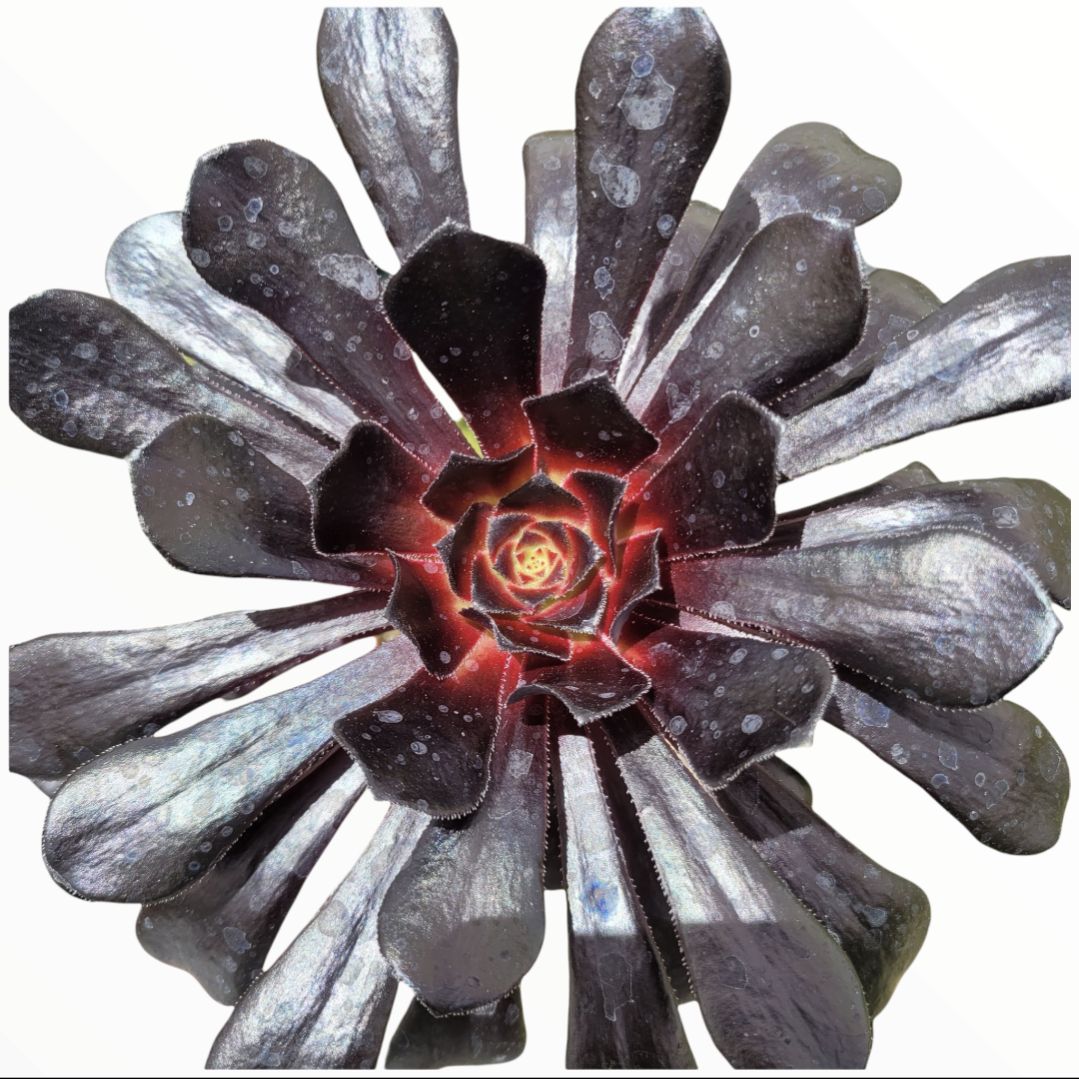
xAeonium arboreum 'Black Rose' is a cultivated species of the genus Aeonium in the Crassulaceae family, originally from the western Canary Islands in Morocco. The purple-black leaves are arranged in rosette-like cascades, giving a sense of solemnity and mystery, with high ornamental value. It should be grown in a well-drained and permeable medium.
The plant is shrubby and growing upright with branched old stems that are cylindrical and light brown. The fleshy leaves are slightly thin, integrated into a 6" daisy-shaped rosette of leaves at the tips of the branches. The leaves are oblong-ovate or oblanceolate with apices being 2" long. The leaf margins have white eyelash-like teeth, and the leaves are blackish purple. In winter, they could get greenish purple if they don't receive sufficient sunlight.
Black Rose is tends to absorb heat more than typical succulents because the leaves themselves tend to turn black, so too much sunlight will cause the leaves to soften. It belongs to the "winter type" of succulent plants, and the bottom leaves will wither in summer when it is dormant, which is a normal metabolism. It grows in the cool season and is dormant in summer but not for long.
Care Tips
Light: Place the plant in semi-shade in high summer. In winter, you need plenty of light. Turn the potted plant regularly to ensure that it receives even light so that the plant's body form does not bend.
Water: Under normal growth conditions, Black Rose should be watered once every 2 weeks to ensure that the potting soil is damp, if the potting soil is too wet, it is easy to cause stem and leaf excessive growth. In summer, the Black Rose is dormant in a high temperature and humid environment. In winter, the room temperature is low, watering should not be too much to ensure that the potting soil is slightly wet.
Soil: The soil requirements must be loose and breathable. This will not only facilitate the breathing condition of the root system, but also effectively avoid the occurrence of waterlogging, which is beneficial to its growth in such an environment.
Potting: Choose high pots, and the bottom of the pot needs to have drainage holes. It is recommended to use ceramic pots. Ceramic pots have a certain degree of permeability. Clay pots lose water too quickly, plastic pots tend to retain water for too long and permeability is poor.
Temperature: The optimum growth temperature is 68-77°F (20-25℃). In winter, if the minimum temperature is not lower than 51.8°F (11℃), the plants can be watered normally so that they can continue to grow, but there is no need to fertilize. If you can't maintain such a high temperature, you can water moderately and make the plant dormant, and it can also tolerate a low temperature of 39.2-42.8°F (4-6℃).
Humidity: Black Rose grows well in average household humidity levels when grown indoors. Does not like too much humidity. Normal household humidity is good for this plant.
Shipping & Handling
- The 2 Inch Black Rose plants are shipped with the pot and soil
- The 4 Inch and larger plants are shipped bare roots without the pot and soil:
- We commit to shipping bare roots, which requires more time and labor, and provide excellent quality and service to our customers - see Benefits of Shipping Bare Roots
- You will receive a very similar plant to the one shown in the photos; shape and color may vary
- Ship within USA & its outlying territories only
- Please visit Order Processing & Shipping info page for additional details
Care Instructions
Please visit our Succulent Care info page for more details.
To ensure the health of succulents, it is important to plant them in porous, well-draining soil. Succulents require little watering, but don't like to sit in wet soil. To create an adequate cactus mix, simply add pumice, perlite, or grit to cactus soil to provide the proper drainage.
Make sure to leave drought periods between waterings to prevent the plant from water-logging.
Weather Conditions
- When ordering, be mindful that living succulents can be damaged by the cold weather.
- If you live in an area that is below 40 degrees Fahrenheit, please add a shipping warmer to your order or consider purchasing plant until the weather is more suitable.
- Shipping Warmer: 72+ Hours Heat Packs available for $1.7 each


- Choosing a selection results in a full page refresh.